I’ve talked about how technology and AI are often detrimental to human well-being…
… how these modern conveniences have been turned against us.
Now, Dr. Sharon Maxwell, PhD dove into this topic in regards to children and adolescents and their development.
Even if you don’t have children, read this and think about how this has been shaping your time…
… your way of thinking…
While we always think of children and adolescents as the ones learning, developing, and growing, our adult brains do, too.
At least, our adult brains will if we allow the opportunity and the time for it (and we won’t find either on a screen).
So, as you read this, think about your own learning, human interactions, tolerance levels, etc (and realize, there are people who think ChatGPT is their friend… their best friend, even).
The Cost of Digital Convenience
We can begin by thinking less in terms of managing devices and more in terms of protecting development. There is a principle long understood in both human development and chiropractic care: the body grows stronger through use, resistance, and adaptation.
When a child learns to walk, the resistance is gravity. The body is not yet sufficiently developed to balance itself in response to that resistance. Again and again, the child pulls up, loses balance, falls, and tries again. Through that persistent effort, the body develops the strength, balance, and coordination walking requires. The same principle applies throughout childhood.
For most of human history, childhood unfolded in environments that required children to adapt to small, everyday forms of resistance. They had to wait, improvise, negotiate, persist, and adapt. Today, many of the technologies surrounding children are designed to do the opposite. They reduce friction, provide immediate gratification, and keep children engaged for as long as possible.
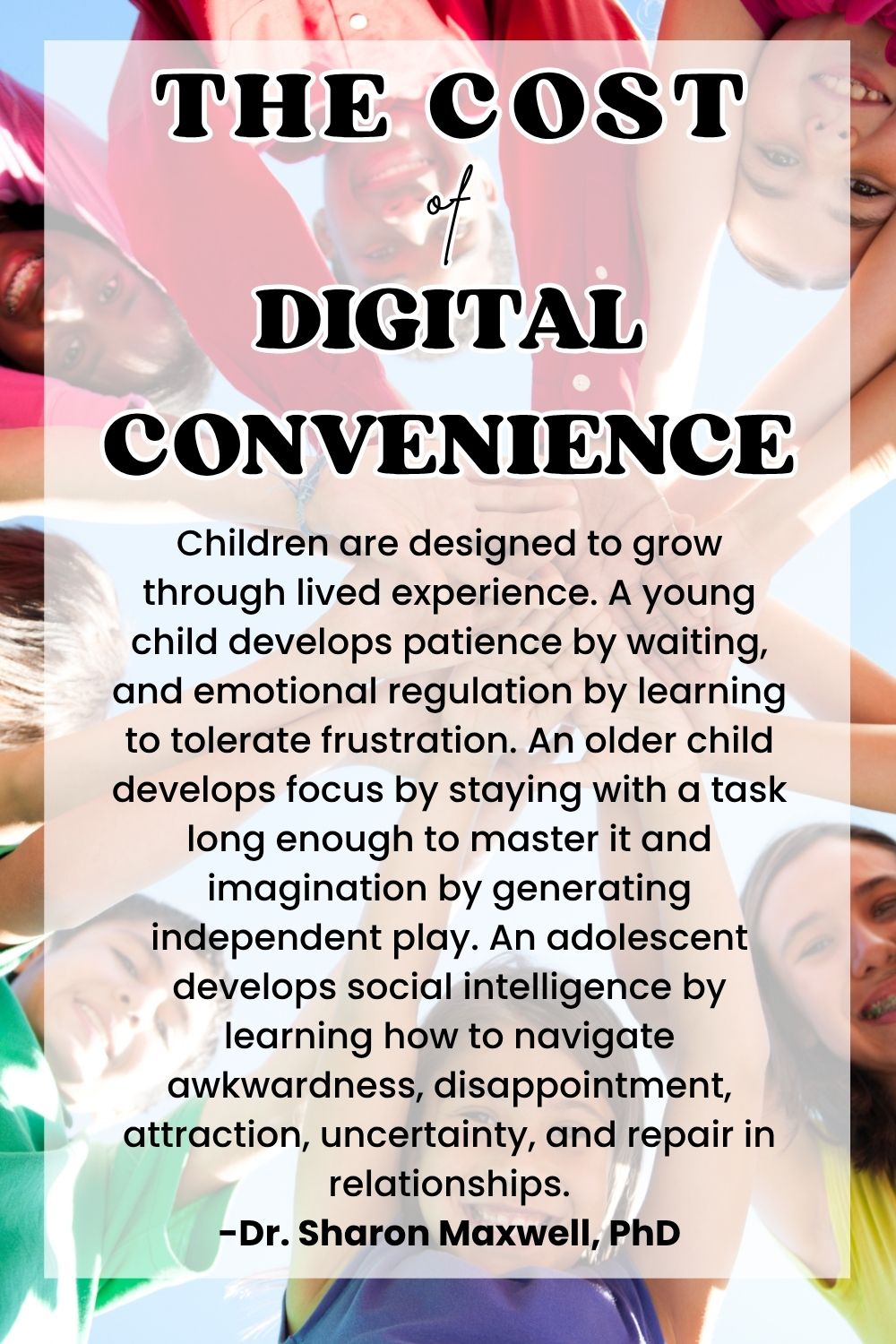
Children are designed to grow through lived experience. A young child develops patience by waiting, and emotional regulation by learning to tolerate frustration. An older child develops focus by staying with a task long enough to master it and imagination by generating independent play. An adolescent develops social intelligence by learning how to navigate awkwardness, disappointment, attraction, uncertainty, and repair in relationships.
These capacities, many of which become developmental milestones, unfold in response to what the environment requires. That is why time spent in digital environments matters so much.
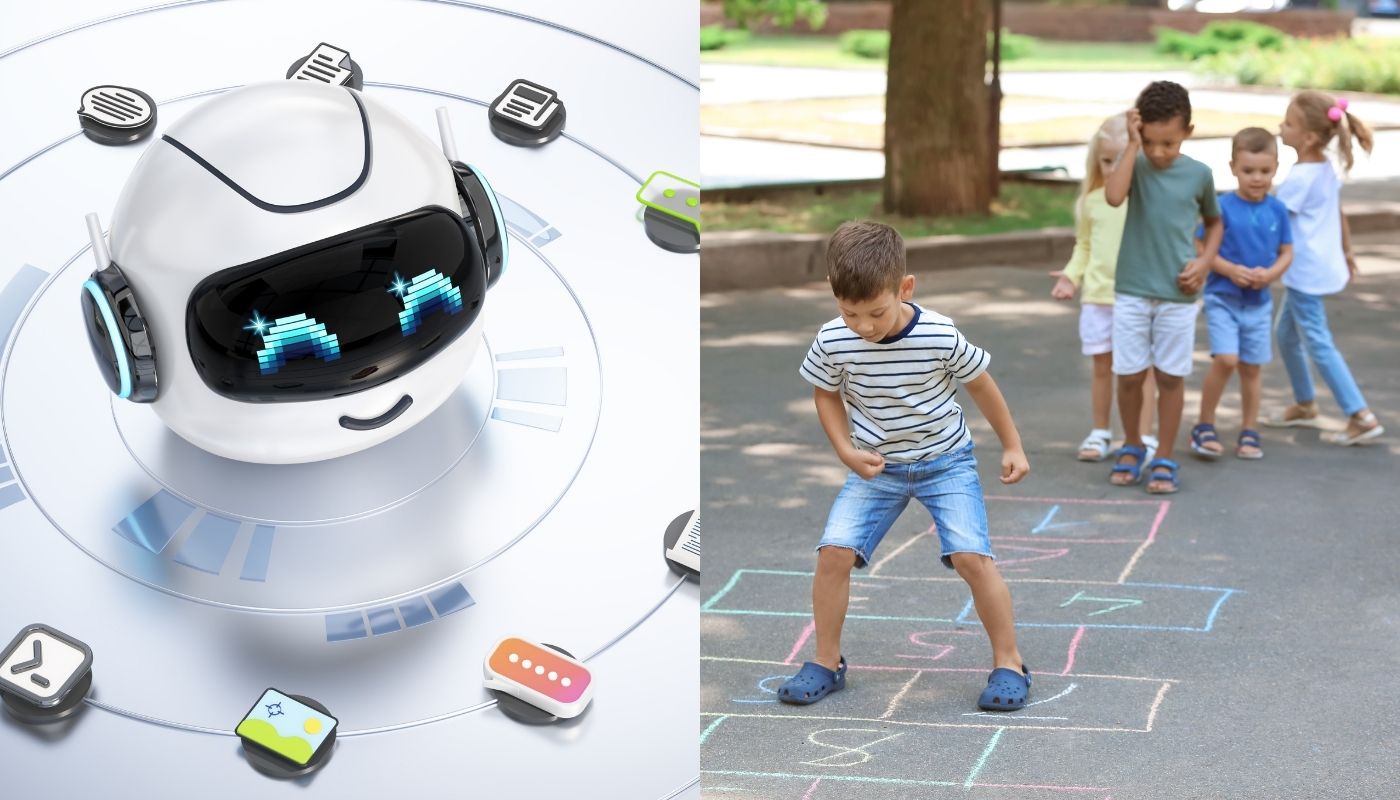
A toddler given an AI pet may be happily occupied, but something more is happening. The child is beginning to learn what relationship is. A real relationship makes demands. It requires patience, and compromise. An AI companion offers the appearance of connection while remaining easy, accommodating, and always available.
The same is true in play. A child building with blocks, making up a game, or figuring out how to join other children is doing important developmental work. That child is tolerating boredom, generating ideas, reading cues, negotiating rules, and adapting when things do not go as planned. These ordinary moments are how a child’s inner capacities grow.
Digital play works differently. The entertainment is already structured. The stimulation is provided, not worked for. The rewards are immediate. The child does not need to generate the experience; the experience is delivered to them. By school-age, children have often been introduced to gaming and other forms of digital entertainment. Designed to be addictive, they train the brain to expect rapid feedback, novelty, and immediate reward. Activities like reading, having a conversation, even watching a movie feel slow and boring by comparison.
By adolescence, the developmental impact becomes even more pronounced. The teen years are a time of rapid social, emotional, and neurological growth. Adolescents are building identity, learning intimacy, managing strong feelings, and developing the capacity to think for themselves in the presence of peer influence. This work depends on real-life experience. It requires vulnerability, face-to-face contact, and the ability to stay present through moments that are awkward, or emotionally demanding.
Digital communication reduces that friction. Texting is easier than talking. Curating an image is easier than revealing oneself. Online contact can create the feeling of connection while bypassing many of the experiences through which confidence and empathy grow.
A college freshman recently shared that she was having a hard time making friends. When I asked whether she had tried joining any clubs, she said that being with people in person made her anxious. “It was just too hard,” she said. She would rather text.
She did not want to avoid opportunities for connection. She was heartbreakingly lonely. But the environment in which she had learned how to connect had been more controllable and less emotionally demanding than real life. She had less practice with the awkward but necessary experiences through which social confidence and resilience are built.
This is the deeper issue parents need to consider. Digital technology does not simply entertain children. It shapes the environment in which development is taking place. The platforms and AI tools now surrounding children are designed to capture and hold attention for as long as possible. They are built to steal time. A child’s brain is shaped by how they spend their time, what experiences fill it, and which capacities are called into use again and again. What a child does repeatedly grows the neural pathways in their brain, becoming who they are and how they understand the world.
We are often asked, “How much time is OK for my child to spend online?” The better question is “What opportunities is time spent online replacing?” What forms of boredom, quiet reflection, conversation, frustration, creative play, physical movement, and real-world effort are being displaced? Are our children spending a sufficient amount of time in real-world environments to develop the capacities they need to become healthy, responsible adults?
As parents, we also have to be honest about how much we have come to rely on the convenience that digital technology provides. Screens buy us time to attend to things we need to get done. It keeps children occupied. It reduces conflict. It calms tantrums in the grocery store, boredom in the car, allows dinner to be made in peace. This reliance is understandable. Parents are under enormous pressure, and convenience can feel like relief.
But this kind of convenience is not benign.
An environment that makes life easier in the short term may make life much harder in the long run. Ask any parent who has tried to take a device away from a child. When a device consistently steps in to relieve boredom, quiet distress, occupy attention, or avoid struggle, it is also reducing the very experiences through which children learn to generate ideas, tolerate frustration, regulate themselves, and engage with others.
What, then, can parents do? We can begin by thinking less in terms of managing devices and more in terms of protecting development. For young children, this means protecting unstructured play, movement, sensory experience, and real human interaction. It means not giving children technologies that simulate relationship when what a child most needs is practice in the richer, more demanding work of real connection. It means allowing room for discomfort, because these are the prerequisites of imagination and resilience.
For school-age children, it means protecting time for reading, outdoor play, chores, hands-on activity, conversation, and the slower satisfactions that can only be achieved through effort and mastery. It means remembering that not every moment needs to be optimized, entertained, or made easy.
For adolescents, it means protecting opportunities for face-to-face friendship, real conversation, awkwardness, repair, responsibility, and time alone with their own thoughts. AI chatbots are not their friend and should not be an option.
Every convenience the digital world has to offer comes with a price. The resistance and discomfort that grows healthy children also grows strong and resilient parents. Many parents are joining together to support each other in creating healthy environments for children.
There are organizations led by parents and educators who are questioning the need to introduce digital technology in schools.
In our decades of work with families, children, and teens, we have come to a few simple conclusions:
• Delay digital technology as long as you can.
• Understand the developmental capacities your child is working to build, and limit technologies that weaken that development.
• Actively protect the experiences that make children stronger—unstructured play, boredom, conversation, chores, reading, outdoor time, real friendship, and time for reflection.
• And when you decide to give your child access to digital technology, unfold it a step at a time with the education they need to use it effectively. Parenting in the digital age is hard, and parents need both education and the support of like-minded families and educators. It helps to remember that easy is not always better, and that the right amount of struggle, boredom, and discomfort is part of how children grow into strong, resilient human beings.
– By Sharon Maxwell, PhD Appears in Pathways to Family Wellness Magazine Issue #90
Having read this now, what do you think?
I’m not demonizing all technology, I see good aspects, and I’m not demonizing all AI – if it’s to assist a surgeon for better outcomes, where the surgeon still calls all the shots, that can be beneficial.
But as far as being human goes, our ability for growth, adaptation, and especially our ability to create… it doesn’t happen inside a screen (I say inside because of how people get sucked right into that stuff).